How to Start a Family Birdwatching Notebook Without Knowing Every Bird
Build a simple family birdwatching notebook around descriptions, sketches and honest uncertainty, with a short observation activity that works before you know species names.
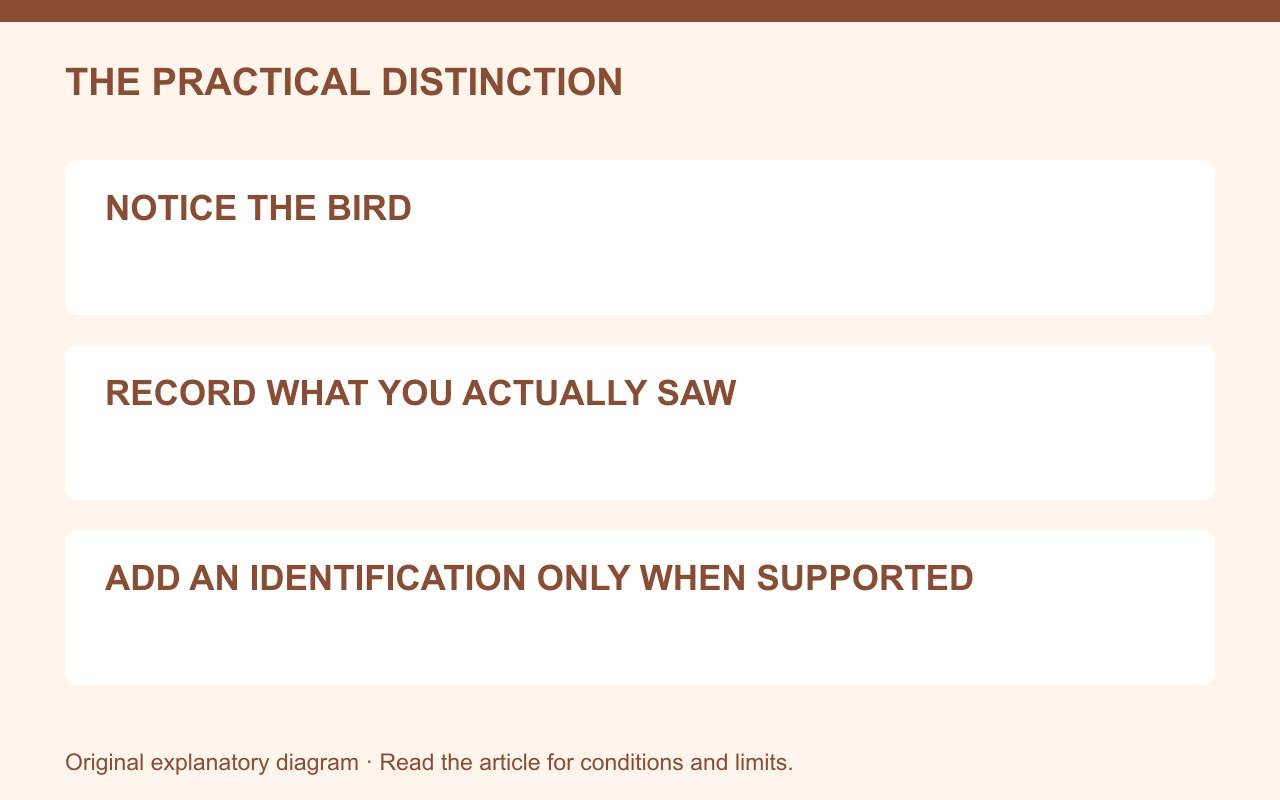
A family birdwatching notebook can begin with an unnamed bird. You do not need to recognise every call, own a powerful camera or produce a polished drawing before the first page is worth keeping. Record a few details about what you saw, where you were and what the bird was doing. Identification can follow when the evidence supports it.
Choose a small observation rather than a long expedition
Start from a safe, comfortable place where birds can be watched without being approached. A window, a permitted path or an ordinary outdoor sitting place may be enough. The National Park Service suggests watching a bird for a few minutes and describing its behaviour. That gives the activity a manageable focus without requiring an impressive total of species.
Agree that the bird’s space comes first. Stay on permitted routes, keep a respectful distance and avoid disturbing nests or pursuing an animal for a better photograph. An observation ending when a bird leaves is a normal outcome. The notebook should reward attention rather than pressure the family to make wildlife perform.
Set up one page with a few useful fields
Cornell’s field-notebook advice emphasises retaining original observations. For a household notebook, a simple page can preserve the details before memory replaces them with a more confident story. Choose an arrangement the participants can use easily, including drawings, dictated words or another suitable communication method.
| Page field | An example of what to record |
|---|---|
| Date and approximate time | When the observation happened |
| Place and habitat | Garden, pond edge or woodland path |
| Size and shape | A comparison with a familiar bird, if known |
| Colours and marks | Features actually visible rather than guessed |
| Behaviour | Hopping, climbing, feeding or flying |
| Identification | A supported name, a possibility or “not identified” |
The examples describe a recording method, not sightings made for this article. You can leave a field blank. Missing a detail is better represented by an empty space than an invented answer that later appears to be part of the original observation.

Look before reaching for the guide
Cornell’s beginner advice recommends noticing size and shape, colour pattern, behaviour and habitat. Those clues are useful even when the family does not yet know how they fit an identification. Spend a short moment noticing the bird rather than immediately searching a screen while it disappears.
Give people different roles if that makes the activity easier. One person might describe the main colours, another note the behaviour and another hold the notebook. Roles can change on the next sighting. Do not turn them into a test in which the youngest observer must remember the least interesting details while everyone else uses the binoculars.
Keep descriptions distinct from guesses
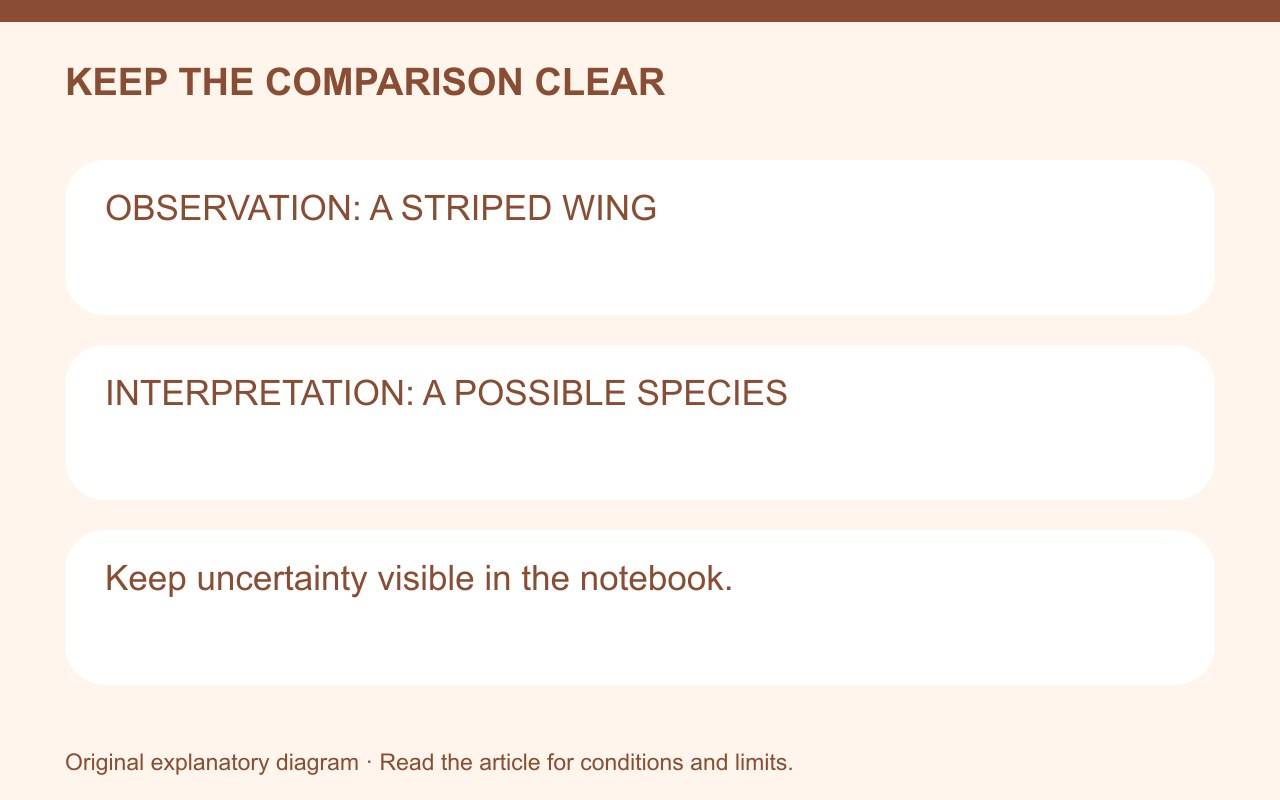
Suppose a child says the bird has a striped wing and is hopping beneath a hedge. Record those observations first. A later field-guide comparison might suggest a species, but write the level of certainty honestly. “Possibly” and “not enough detail” are useful outcomes, not failed entries.
Keep an early sketch even if a later page is neater. A rough outline may preserve the position of a mark better than a tidy redraw made after looking at a guide. If a photograph exists, it can provide another reference, but it is not necessary to make every entry complete. Avoid sharing precise sensitive wildlife locations simply to make a public record look more detailed.
Return to a familiar place and compare the pages
On another suitable day, revisit the same safe observing place. Notice what is similar and what is different, while recording the conditions rather than assuming the difference has one cause. A quiet visit does not establish that a species has vanished. Time, weather, season and where you looked can all affect the observation.
Our family nature-walk guide offers broader ways to keep an outing engaging. The notebook adds a narrower purpose: preserve one observation well enough that the family can discuss it later. A single useful page can be enough for the day.
Finish by letting each person choose one detail they would like to notice next time. The activity can grow from repeated curiosity rather than a target number of correct names. A family birdwatching notebook becomes valuable through honest attention to the birds and to one another, with room for unanswered questions on every page.